
Equity tokenization converts company shares into digital tokens on a blockchain. Each token represents a real ownership stake - with the same legal rights, dividend entitlements, and voting power as a traditional share. The difference is in how those shares are issued, recorded, and transferred: on a distributed ledger instead of paper certificates or centralized registries.
For private companies, this changes the economics of equity management. Share issuance becomes faster. Ownership transfers happen without notarized documents. And for the first time, private shares can be traded in structured secondary markets - without the cost of a public listing.
This guide covers how equity tokenization works, what legal frameworks support it, and what Swiss companies need to know before tokenizing their shares in 2026.
Why equity tokenization matters now
For most of the last century, ownership of private company shares was tracked through physical certificates, notarized transfers, and spreadsheet-based cap tables. The process worked - but it did not scale.
A Swiss AG with 50 shareholders can manage transfers manually. One with 500 cannot. Every transfer requires paperwork, board approval, registry updates, and often legal review. This friction creates what economists call the "illiquidity discount" - investors demand steep price reductions (sometimes 30–80%) simply because private shares are difficult to sell.
Tokenization eliminates most of this friction. By recording shares on a blockchain, companies create a single, tamper-proof source of truth for ownership. Transfers settle in minutes instead of weeks. And structured trading infrastructure becomes possible without the CHF 5–10 million cost of a traditional IPO.
The market reflects this shift. Tokenized real-world assets grew from roughly $85 million in 2020 to over $21 billion by early 2025. Institutional adoption is accelerating - approximately 86% of surveyed institutional investors had exposure to, or planned to allocate capital to, digital assets by early 2025. And regulatory frameworks in Switzerland and the EU now provide clear legal grounding for tokenized securities.
This is no longer experimental infrastructure. It is operational capital-markets plumbing.
How equity tokenization works: step by step
Tokenizing company shares involves five key steps. The complexity of each depends on the legal jurisdiction, the blockchain used, and the tokenization provider.
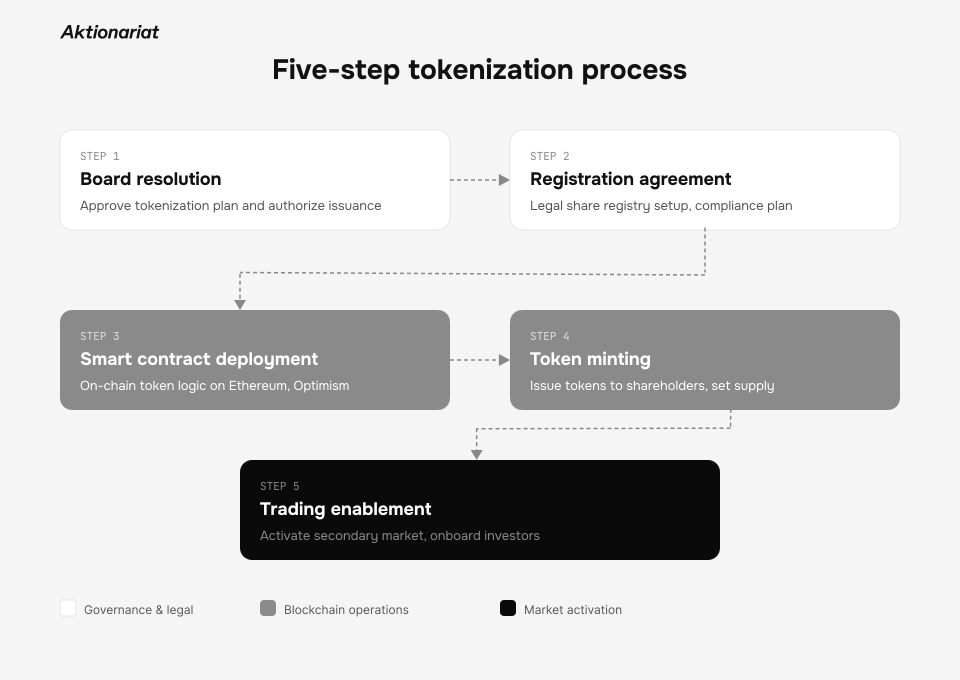
Image 1. How equity tokenization works in Switzerland - 5 steps from board resolution to trading
1. Board resolution and statutory basis
In Switzerland, tokenization begins with a formal board resolution. The company's articles of association must explicitly allow shares to be issued as ledger-based securities under Article 973d of the Swiss Code of Obligations. This statutory basis creates transparency and ensures shareholders have approved the tokenization structure.
2. Define the tokenization terms
The company and its legal advisors draft a registration agreement (Registrierungsvereinbarung) - a document that defines the relationship between the digital token and the underlying share. It specifies how transfers work, what rights attach to the token, and which blockchain is used as the securities ledger.
3. Deploy the smart contract
A smart contract is deployed on a public blockchain (typically Ethereum). This contract defines the total supply of tokens, manages ownership records, and enforces transfer rules - such as allowlisting for KYC-verified investors or drag-along clauses. Open standards like the CMTAT framework, developed by the Capital Markets and Technology Association, allow companies to use audited, widely accepted contracts rather than building proprietary code.
4. Mint and distribute tokens
Tokens are minted and assigned to shareholders. Existing shareholders can convert their traditional shares to tokenized form, or new shares can be issued directly as tokens. Both tokenized and traditional shares can coexist within the same share class.
5. Enable management and trading
With tokens live on the blockchain, the company can manage its cap table digitally, run shareholder votes, and - if desired - enable primary or secondary trading. Investors hold their shares in self-custody wallets, and all transfers are recorded immutably on the ledger.
The legal framework: Switzerland's DLT Act
Switzerland was among the first countries to create a comprehensive legal framework for tokenized securities. The Federal DLT Act, adopted in September 2020 and fully effective since August 2021, amended existing laws rather than creating new ones - an approach the Swiss government calls "technology-neutral regulation."
What the DLT Act introduced
The law created a new category of instrument called ledger-based securities (Registerwertrechte) under Article 973d of the Swiss Code of Obligations. A ledger-based security is a right that is registered in a securities ledger and can only be asserted and transferred through that ledger.
For a distributed ledger to qualify as a securities ledger under Swiss law, it must meet four requirements:
- Power of disposal. Shareholders - not the company - must have technical control over their tokens. The issuer cannot unilaterally move or freeze shares.
- Integrity. The ledger must be protected from unauthorized modification through technical and organizational measures, such as decentralized consensus mechanisms.
- Transparency. The ledger or linked documentation must describe the tokenized shares, the registration agreement, and how the system functions.
- Verifiability. Shareholders must be able to inspect the ledger entries that concern them and verify the ledger's integrity independently.
Public blockchains like Ethereum satisfy these requirements because no single entity controls the network, transactions are cryptographically secured, and anyone can verify the ledger state.
What this means for companies
The practical consequence is significant: a Swiss AG can now issue legally binding shares as tokens on a public blockchain, without needing a bank, a central securities depository, or a regulated intermediary for the issuance itself. Transfer no longer requires a written deed of assignment — a blockchain transaction is sufficient.
This removes structural barriers that previously made share transfers expensive and slow for private companies.
FINMA's classification
The Swiss Financial Market Supervisory Authority (FINMA) classifies tokenized shares as "asset tokens" - tokens that represent claims analogous to equities, bonds, or derivatives. Depending on the structure of the offering, additional rules around prospectus requirements, AML compliance, and investor eligibility may apply.
Tokenized shares vs. traditional shares
From a legal perspective, tokenized shares carry the same rights as traditional shares. The differences are operational and structural.
| Dimension | Traditional shares | Tokenized shares |
|---|---|---|
| Ownership record | Paper certificates or centralized registry | Blockchain-based ledger |
| Transfer process | Written assignment, board approval, registry update | On-chain transaction, settles in minutes |
| Transfer cost | Legal fees, notary, administrative overhead | Network gas fee (fractions of a cent on Layer 2) |
| Settlement time | Days to weeks | Minutes |
| Accessibility | Limited to existing shareholder network | Open to any KYC-verified investor with a wallet |
| Cap table management | Spreadsheets or specialized software | Real-time, on-chain, always synchronized |
| Secondary trading | Rare for private companies | Possible via structured on-chain markets |
| Compliance | Manual tracking | Programmable (allowlists, drag-along, voting built into the smart contract) |
| Custody | Held by company or intermediary | Self-custody by the shareholder |
The key insight: tokenized shares are not a different asset class. They are the same legal instrument - shares in a Swiss corporation - represented and managed through more efficient infrastructure.
Use cases: who tokenizes and why
Private companies seeking investor access
For Swiss SMEs that are too small for a public listing but too large for informal share management, tokenization opens a middle path. Companies can raise capital from a broad investor base - through crowdinvesting or structured direct offerings - without the regulatory burden of an IPO.
Companies with growing shareholder bases
Once a company has more than 50–100 shareholders, managing transfers, voting, and reporting manually becomes unsustainable. A tokenized cap table automates these workflows: transfers update the registry in real time, voting can happen on-chain, and reporting is always current.
Founders who want structured liquidity
Traditional private shares are effectively locked. Shareholders cannot sell without finding a buyer, negotiating a price, and completing a manual transfer. Tokenization enables secondary trading through structured markets - allowing shareholders to buy and sell at transparent, market-determined prices.
Companies planning phased exits
Tokenization allows a company to progressively introduce liquidity for its shares over time. Start with a small investor community, grow organically, and eventually transition to a licensed trading venue — without the all-or-nothing decision of an IPO.
The technology stack
Equity tokenization relies on three layers of technology: the blockchain, the smart contract, and the application layer.
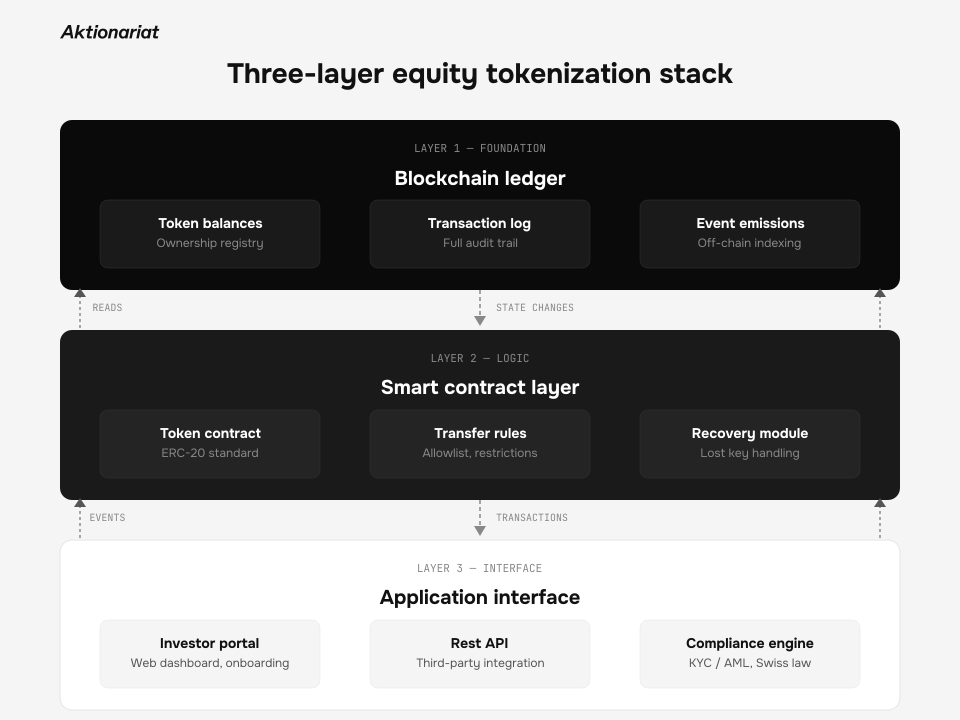
Image 2. The equity tokenization technology stack
Blockchain (the ledger)
The blockchain serves as the securities ledger under Swiss law. Most equity tokenization in Switzerland uses Ethereum or one of its Layer 2 networks (Optimism, Polygon). Layer 2 networks offer the same security guarantees as Ethereum mainnet, but with significantly lower transaction costs - often less than CHF 0.01 per transfer.
Smart contract (the rulebook)
The smart contract is a program deployed on the blockchain that governs the token. It defines who can hold tokens (through allowlists), how transfers work, and what corporate actions are possible — including drag-along clauses, share splits, and dividend distributions. The CMTAT standard, published by the Capital Markets and Technology Association (CMTA), is the most widely used open framework for Swiss equity tokens.
Application layer (the interface)
End users - both companies and shareholders - interact with tokenized shares through software applications, not directly with the blockchain. For issuers, this means a dashboard for managing the cap table, approving transfers, and running corporate governance. For investors, it means a portfolio application for viewing holdings, executing trades, and participating in shareholder votes.
Risks and considerations
Equity tokenization is maturing, but it is not without trade-offs.
Smart contract risk. Like all software, smart contracts can contain bugs. Using audited, open-source standards (such as CMTAT) and working with established providers mitigates this risk, but does not eliminate it entirely.
Key management. Self-custody means shareholders are responsible for securing their own private keys. Loss of a private key can mean loss of access to shares. Institutional-grade custody solutions and recovery mechanisms are available, but add complexity.
Regulatory evolution. While Switzerland's DLT Act provides a clear framework, the regulatory landscape in other jurisdictions remains fragmented. Cross-border transferability of tokenized shares requires careful legal analysis.
Market depth. Secondary markets for tokenized private shares are still small. Liquidity depends on the number of active participants, and newly tokenized companies may experience thin order books initially.
Thin liquidity. Unlike publicly listed stocks with deep order books, tokenized private shares may have limited buyers or sellers at any given time — particularly in the early months after tokenization.
These are manageable risks, not disqualifying ones. The operational benefits of tokenization - reduced administration, faster settlement, broader investor access - typically outweigh the trade-offs for companies that have outgrown manual share management.
What tokenization costs in Switzerland
Cost transparency is important for any company considering tokenization. Here is what Swiss companies typically pay.
Platform setup: A one-time fee for deploying the smart contract, configuring the issuer dashboard, and setting up the cap table. At Aktionariat, the Tokenization Package includes a setup fee and an annual license fee of CHF 1,500.
Service fees: For companies using primary issuance (direct investment), most providers charge a percentage of capital raised - typically 0.75%–1.5% depending on volume.
Legal costs: Drafting the registration agreement and amending the articles of association requires legal support. Costs vary by law firm, but typically range from CHF 2,000 to CHF 15,000 for a standard share tokenization.
Blockchain fees: Transaction costs on Layer 2 networks are negligible - often less than CHF 0.01 per transfer. Ethereum mainnet transactions cost more.
Ongoing costs: Cap table management, shareholder communication, and compliance reporting are included in most platform fees. There are no per-shareholder costs.
For comparison, a traditional IPO on SIX Swiss Exchange costs CHF 5–10 million or more in advisory, legal, and regulatory fees. Tokenization offers a path to structured equity markets at a fraction of that cost.
The market in 2026
Equity tokenization sits within the broader trend of real-world asset (RWA) tokenization - one of the fastest-growing segments in digital assets.
The tokenized asset market (excluding stablecoins) grew from $85 million in 2020 to over $21 billion by early 2025. Forecasts project that total tokenized real-world assets could reach $18–19 trillion by the early 2030s, driven by institutional adoption, regulatory clarity, and maturing infrastructure.
In Switzerland specifically, the combination of the DLT Act, the CMTA standards framework, and licensed trading venues like Taurus Digital Exchange (TDX) or BX Digital has created a full-stack ecosystem for tokenized securities - from issuance through custody to secondary trading. This regulatory and infrastructure maturity is why many international observers consider Switzerland the leading jurisdiction for security tokenization.
Getting started with equity tokenization
For Swiss companies considering tokenization, the process is simpler than it was even two years ago.
Step 1: Assess your needs. Are you looking to simplify shareholder management, raise capital from new investors, or create liquidity for existing shareholders? The answer shapes the tokenization structure.
Step 2: Update your articles of association. Your company's articles must permit the issuance of ledger-based securities under Art. 973d CO. This typically requires a shareholder resolution.
Step 3: Choose a tokenization provider. Look for a platform that handles the full lifecycle - issuance, cap table management, compliance, and trading infrastructure. Aktionariat offers all of these as an integrated ecosystem, purpose-built for Swiss law.
Step 4: Deploy and distribute. With the smart contract deployed and your cap table configured, you can begin issuing tokenized shares to new or existing shareholders.
Step 5: Enable trading (optional). If desired, activate primary or secondary trading through your Investor Page. Investors can discover, buy, and trade your shares through a branded, compliant interface.
Companies can start for free with the Aktionariat Issuer Portal - which includes digital shareholder management and a share register - and add tokenization when ready.
FAQ: Equity tokenization
Are tokenized shares real shares? Yes. Under Swiss law, tokenized shares issued as ledger-based securities under Art. 973d CO carry the same legal rights as traditional shares - including voting rights, dividend entitlements, and ownership claims.
Do I need to tokenize all my shares? No. Companies can choose to tokenize a portion of their shares while keeping the rest as traditional shares. Both forms can coexist within the same share class.
Can existing shareholders convert their shares? Yes. Existing shareholders can convert their traditional shares to tokenized form through the Aktionariat Portfolio App.
Is a prospectus required? It depends on the size and structure of the offering. Swiss law provides exemptions for smaller offerings. Companies should consult a legal advisor to determine which rules apply.
What blockchain is used? Most Swiss equity tokens are issued on Ethereum or its Layer 2 networks (Optimism, Polygon, Base). The choice of blockchain affects transaction costs and speed, but not the legal validity of the shares.
How do investors buy tokenized shares? Through the company's Investor Page, investors can purchase tokenized shares directly - paying with cryptocurrency or bank transfer. Secondary trading between investors is also possible.
Can tokenized shares be traded on a stock exchange? Not on traditional exchanges. However, licensed DLT trading venues like Taurus Digital Exchange (TDX) in Switzerland now support tokenized share trading for qualifying companies.
Aktionariat is the leading Swiss tokenization provider. 85+ companies have tokenized equity on the platform. Book a demo to see how tokenization works for your company.


